

Do you own a rental property occupied by low-income households, manage a housing cooperative, a non-profit organization (NPO) or a municipal housing office (MHO), or represent a community-based organization serving disadvantaged clients?
If so, you have likely observed that many of these individuals face what is known as energy poverty—that is, difficulty paying their energy bills.
Increase your grants to help improve their living conditions
By applying for a grant under Énergir’s Supplement for Low-Income Households – Business component, you can help improve this situation while receiving additional financial assistance of up to twice the amount received through the following programs:1
- Energy-efficient renovations
- Solar preheating
- Feasibility study
- Variable-speed hood
- Unit heater
- Infrared heating system
- New efficient construction
- Recommissioning
- Boiler system optimization
An increased grant can be a concrete tool for addressing this situation. It not only provides greater financial support to improve your building’s energy efficiency, but also allows you to reinvest part of the funding to increase occupants’ comfort and quality of life while reducing their energy costs.
A win-win investment
The additional amount you may be eligible for depends on the energy efficiency program you are participating in. In all cases, however, the base grant will be increased, and your tenants may also receive a portion of this additional assistance:
Rental properties: Prorated according to the number of low-income households you house
Housing cooperatives, NPOs, MHOs and community-based organizations serving disadvantaged clients: the amount is automatically doubled
10 %
If a household spends 10% or more of its income on utilities, it is experiencing energy poverty. In Quebec, depending on the indicator used, between 9% and 16% of households are in this situation.
What is a low-income household?
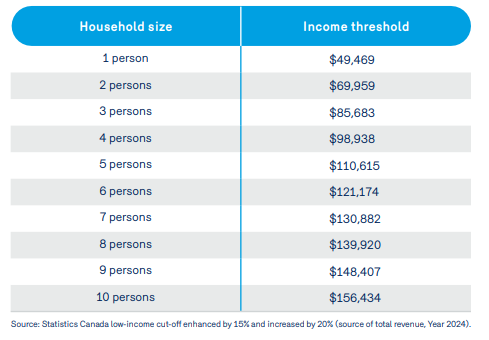
To be considered a low-income household, family income must be equal to or less than the amount shown in the table.
Go further
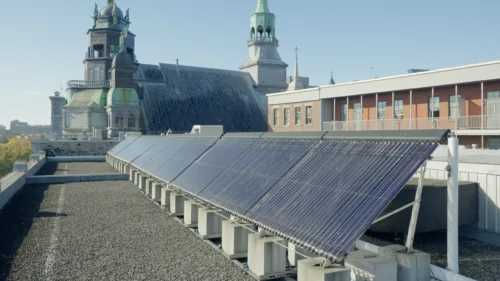
Find out how Accueil Bonneau received a $20,000 grant from Énergir under the Low-Income Household Supplement – Business component to overhaul its solar thermal preheating system and reduce energy costs.
Accueil Bonneau
The rehabilitation of the Accueil Bonneau solar thermal system saves more than 2,500 m3 of natural gas per year.
Legal notices
- Certain conditions apply. Grants subject to change without notice. Check the grant’s webpage for eligibility criteria.
- Fonds de recherche du Québec, “Prévenir et réduire la précarité énergétique : un enjeu de logement, de santé et d’équité pour la transition énergétique au Québec,” project summary: https://frq.gouv.qc.ca/projet/prevenir-et-reduire-la-precarite-energetique-un-enjeu-de-housing-de-sante-et-dequite-pour-la-transition-energetique-au-Quebec/#resume-du-projet (opens in new tab)
- To be eligible, you must own a rental property with four or more units occupied by low-income tenants, manage a non-profit organization or a housing cooperative, or represent a non-profit community-based organization serving disadvantaged clients.